
Collecting Clay - A Red Seam for Earth Pigment Work

Updated: Jan 11

On a crisp December morning, blue skies stretched above Oxcombe as the last traces of frost melted away. I'd come with permission from the landowner, armed with my trusty bulb trowel and a large jam jar—simple tools for gathering something special from this corner of the Lincolnshire Wolds.
The landscape unfolds not quite dramatically but quietly here. Around me vast, gentle hills punctuated by both established trees and young saplings, tracks from cattle imprinted into the earth where the cows and bulls traversed to their winter home, all visible as I passed through a small copse and over a stile.

The last time I visited they were still in the field and my husband and I sent out calm, 'we come in peace' vibes. This time I'd been told they'd been safely tucked away in a shed for the winter. The parish's name, Oxcombe, comes from the Old English oxa + coomb, meaning ox valley; a name that clearly still holds true.
This site-specific commission is one I've been asked to complete for the new visitor centre at Oxcombe Pottery and my some of my materials needed to be rooted in this exact place, in this particular seam of red clay which I use as my earth pigment, that makes this part of the Wolds geologically remarkable.
The pottery lies on Bluestone Heath Road near Oxcombe, along this historic route close to Belchford. It's here we regularly hear kites calling across the clear, vast skies.
rolling hills of a green lincolnshire landscape


The red clay here is part of the Hunstanton Formation, a rare geological feature found only in Norfolk, Lincolnshire, and Yorkshire—the Red Chalk that underlies the white chalk of the Wolds.
On this day, the clay was damp from recent rain, gritty between my fingers—telling me immediately I'd have plenty of sieving and grinding ahead. But for me, that tactile connection matters.

This sensory experience commits a place to memory in a way that visuals on their own can't - perhaps this is why I enjoy working with my hands.


The colours ranged through brick red, rusts, russets—each handful slightly different, each telling its own 100-million-year-old story while my fingers reminded me of the henna dye I used to put on my hair in the 80's.
Although my fingers soon grew numb with cold, stained deep with iron oxide, I prefer to feel the earth rather than wear gloves. It connects me to the landscape, the place, the time. My DNA mingles with the soil—I'm making my mark even as I try not to leave too much of one. I chose not to take too large a sample, just enough in fact, gathering some rocks too. I can go back for more if I need to.
I also collected a few rocks. Though I won't grind these, their form, shape, and colour will inspire the semi-abstract lines I'll later render in stitch and this is also the reason I take so many photos of the landscape. Lots of reference material for my studies.

I hoped for a fossil, perhaps a belemnite, like the one I saw last time I processed clay from this place. When removing the organic matter such as roots and also small stones, a tiny (but still exciting to me) belemnite showed itself to me.
It's a fossilised remnant of a squid-like creature that lived in these warm, shallow seas during the Cretaceous period—a bullet-shaped internal shell, the hard guard that once counterbalanced the animal's soft body.
Finding it felt like the landscape itself was gifting a small peek into a past time.


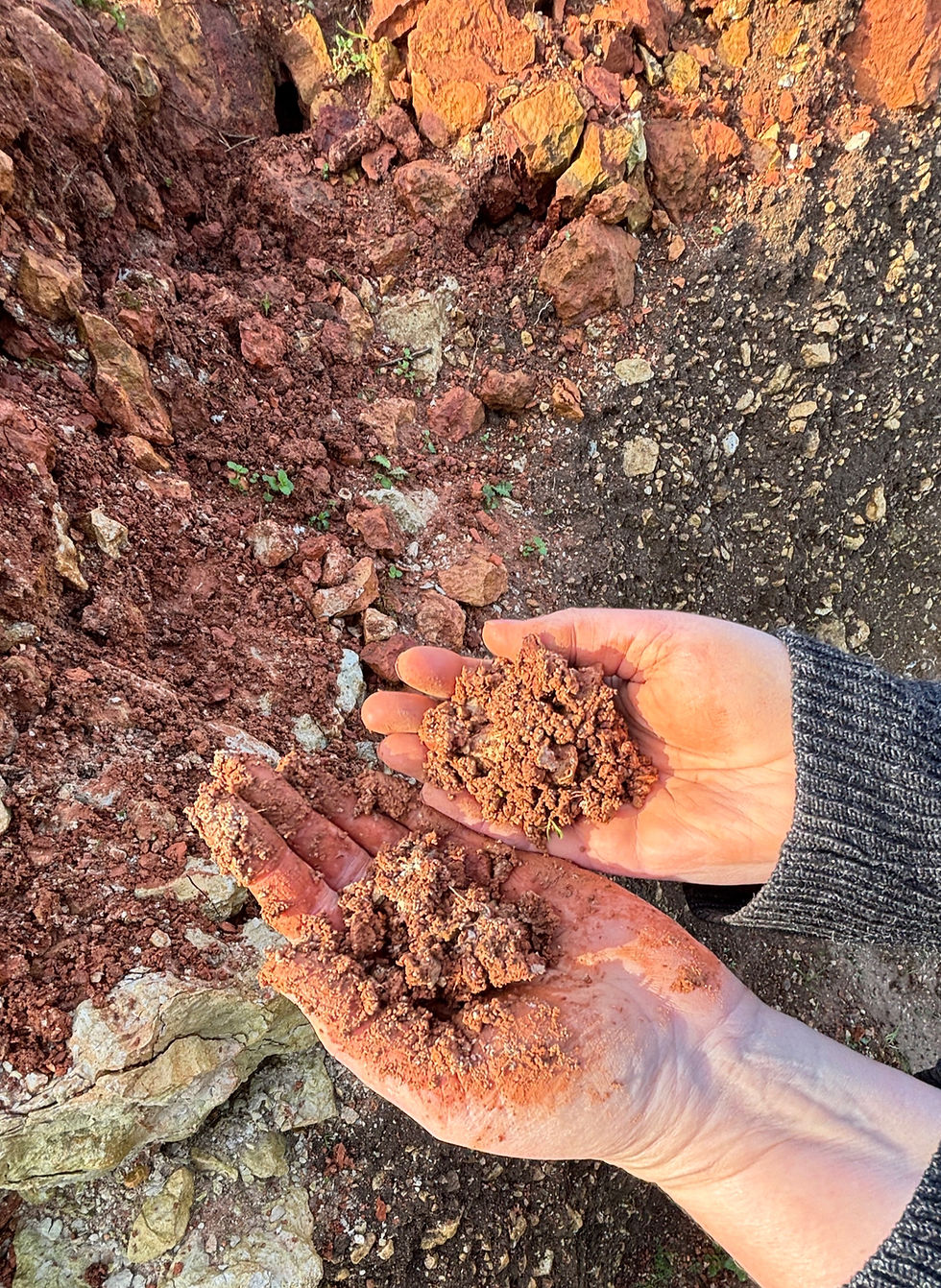

I photographed everything and my husband photographed me...
These images will help me decide later which lines to follow, which connections to trace.
After filling my jar, I walked back through the frost-touched fields to chat with Susanna, the farm owner and a talented potter.

The work ahead feels like the right kind of making—contemporary practice meeting traditional material, sustainable and site-specific, a way of honouring place.
I'm already planning my return.


I discovered fascinating information about the red material I collected at Oxcombe through my dad's old copy of 'The Geology of Britain' by Peter Toghill and various web searches.

From what I found out, this red substance is part of an intriguing geological formation called the Hunstanton Formation. I decided I needed to go there too. I've been meaning to visit for a while.

I learned the formation runs along the western base of the Lincolnshire Wolds. I already knew about the Red Hill Nature Reserve near Goulceby from my motorbike rides there—we last went to the wild flower field on the hottest day of the year.
Since then, I've visited the SSSI each year to see the thousands of cowslips planted over many decades. A place where skylarks sing overhead.
Through research, I discovered this site has a particularly good exposure of the same red seam I found at Oxcombe.
Spending time with the landscape and its materials has shaped how I understand this place and its long history. I’m excited to carry these insights forward as I begin making the textile commission for Oxcombe’s new visitor centre.


Comments