
Processing Oxcombe Red Seam Pigment: From Ancient Ironstone to Artist's Material

A few weeks ago, I spent the afternoon processing more pigment from the red seam at Oxcombe, carefully selecting samples at each stage to create a display for the Visitor Centre, to show people the origins of the pigments in my work.
It's fascinating to watch this ancient Jurassic material transform from raw clay to usable pigment, and I wanted to document a part of the journey these iron oxides take; from the Lincolnshire Wolds landscape into my work.

Against the backdrop of weeks of grey skies and almost persistent rain, the warmth of the Oxcombe clay feels gloriously out of place — those deep terracottas and vivid iron reds glowing on the workbench as though they've been holding onto the sun for million of years.
As I worked through each stage of processing, I filled test tubes to show visitors the complete transformation. Each tube tells part of the story of this remarkable material that's been lying in the ground here. Dried soya beans are also part of this process.
These are what I use to make the protein-rich binder that transforms the processed pigment into something I can paint with. You can see some of how the soya milk is made and used below.
From Raw Earth to Artist's Pigment

One test tube holds chunks of raw ironstone clay straight from the ground.
This Jurassic-age deposit contains a mixture of iron oxide minerals including hematite (that vibrant blood-red colour), goethite (yellow-brown), and limonite.
What's extraordinary is that even within a few centimetres, the colour can vary dramatically depending on the local conditions of when these sediments were formed.
Some pieces, when washed, reveal an almost shocking red - as vivid as blood - while others appear more muted browns and ochres.
One particular piece I was working with gave off such an extraordinarily vibrant red when wet that it startled me. I was listening to the Hamnet audiobook as I worked — I'd hugely recommend it — and couldn't help thinking I looked like Lady Macbeth, although if you know the book she doesnt get a mention!

The vivid crimson seemed to work its way into every crease and under my fingernails, a reminder of just how powerful these iron oxide pigments are and why they've been used for tens of thousands of years. When I later met geologist Paul on a return visit to Oxcombe, he confirmed it was ferric iron — the oxidised form — which is what gives hematite its remarkable red.
The next tube contains the settled clay after levigation - that wet paste stage after washing and decanting.
The first major transformation happens during this washing process. I mix the raw clay with water and let it settle. The heavier impurities sink to the bottom first, while the finest clay particles remain suspended longer before gradually settling as a deep red sediment. This wet paste shows the concentrated iron oxides after I've poured off the washing water.

The hematite-rich portions create this colour that hints at the pigment's potential. It's worth noting that I don't process the rocks themselves, but the clay-rich soil bed surrounding them. It's a messy, meditative process.
After decanting the water, I spread the wet clay out to air dry for a number of days and this dried clay fills the next test tube.

The concentrated iron oxides become more visible, and you can see the variation in colour across the dried material. It's remarkable how different it looks from the wet paste, changing to a more gentle, earthy red as it loses its water. This is when I start to get excited about the final pigment colour, seeing hints of what it will become. The dried clay is now ready for the grinding stages, transformed from sticky paste into brittle fragments that crumble between your fingers.
Another tube shows the coarsely ground stage, after the first grinding breaks down the dried clay into smaller particles.
The following test tube is perhaps the most intriguing from a geological perspective - it contains some removed impurities that I've sieved out during processing. When I say impurities I should clarify - I mean elements I cannot use to make pigment- they are fragments of chalk, bits of organic matter, small stones, and tiny belemnite fossils - those bullet-shaped stones that are actually the internal guards of extinct squid-like creatures from the Jurassic period.
I found one on my first and second site visits that looked almost translucent and crystalline, which reminded me oddly of those fragments of Victorian clay pipe I used to find in the vegetable patch as a child - that same quality of something manufactured and worked, though of course the belemnite is entirely natural.
This rejected material tells the story of the ancient seabed where these clays were originally deposited, offering a glimpse into the landscape as it was millions of years ago.
It would be easy to forget, while focusing on extracting the pigment, that these are the remnants of living ecosystems, of creatures and plants and sediments all compressed together over unimaginable spans of time. This tube of 'waste' for my process is actually a tube of deep time, of fossils and fragments that speak to what Oxcombe once was.

This sense of deep time became even more vivid when I was later invited to meet the two geologists working on the project. Looking at their highly magnified rock photographs and hearing their excitement about particular fossil finds — evidence of ancient marine life, markers of events separated by millennia — made me see the material I'd been handling in a completely different light. I am really excited to see the fossilised sea urchin (an echinoid) completely cleaned up by Paul Hildreth- see last photo in the grid below of it part way through the process.

When I asked Paul, one of the geologists about the colours he saw in the Oxcombe seam he shared,
"The 'Red Chalk' consists of alternating limestones and mudstones that vary in colour from brick-red through orange brown and shades of pink to bluish-green and khaki. Reminds me of having to learn the lines of the song in 'Joseph and his Amazing Technicolour Dreamcoat".
He also shared an 'as yet unpublished revision of the book 'Geology of Lincolnshire' that he is preparing for the Lincolnshire Naturalists' Association.
The colours of the formation listed there are pinkish grey, reddish, orange-red, pale creamy orange, red, khaki, pale bluish, greenish grey, orange, reddish brown, red, pale pinkish, red, reddish brown, greenish grey, greenish grey, and reddish brown.

I'm pleased that much of the palette I've chosen for the final piece reflects what nature has laid down
Yet another glass tube holds the finely ground powder, after the second grinding reduces everything to a uniform consistency.
Yet even at this stage, you can see the subtle variations - reds, ochres, and browns all mixed together, reflecting the different iron minerals present in the original deposit.

This powder is almost ready to use, though some artists prefer to grind even finer depending on their application.
The texture at this stage is soft and silky, and it's starting to look like the pigments you might buy in an art supply shop, though infinitely more interesting because I know exactly where it came from and what journey it's been on.

As I lifted the pestle, a little puff of red dust caught the afternoon light coming through the window — for a moment it looked like powdered rust suspended in air, which was lovely until I remembered why I always wear a mask.
Particles this fine become airborne instantly, and however beautiful they look catching the light, iron oxides aren't something you want in your lungs.

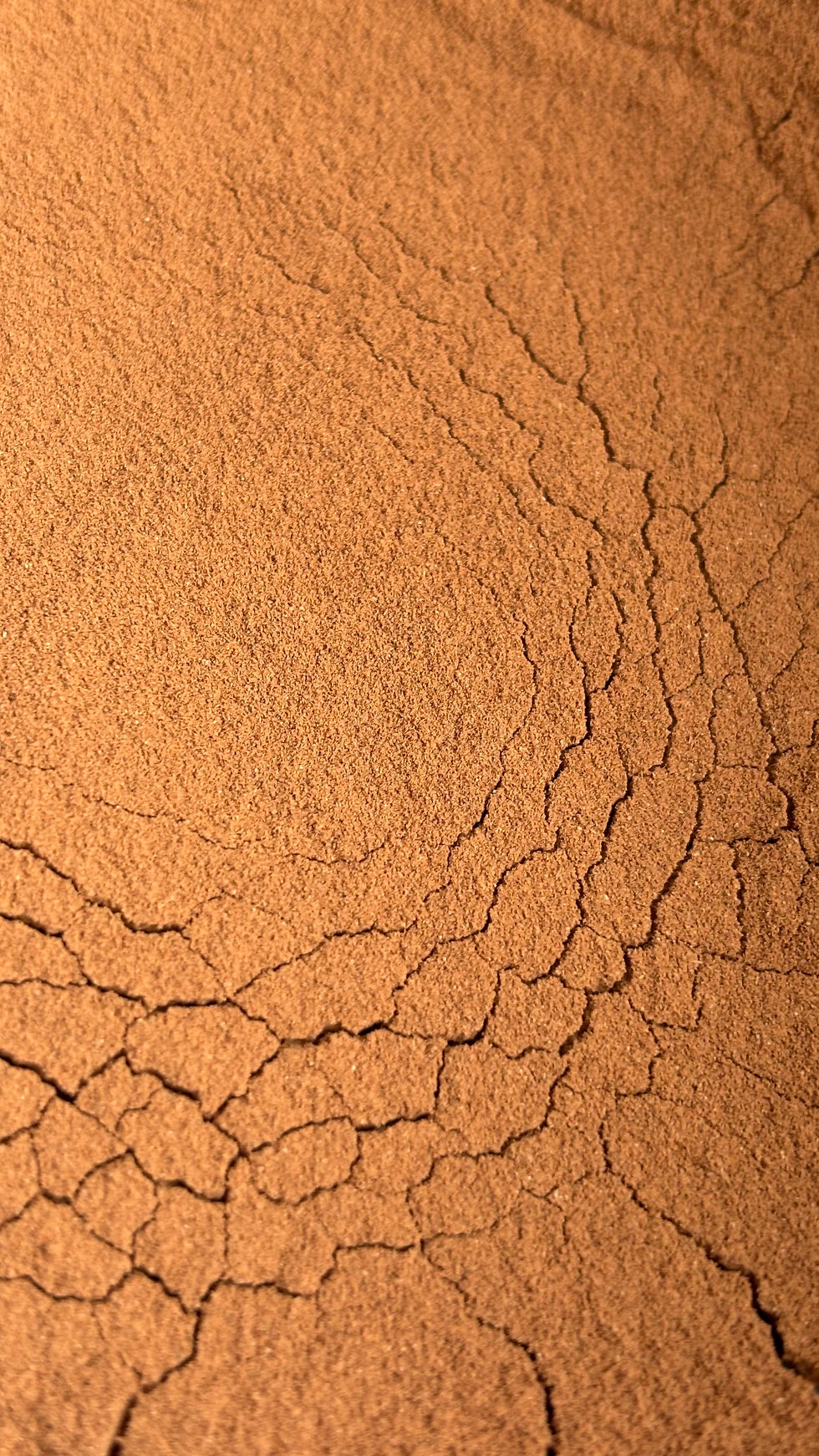
The final tube contains the processed pigment - pure, usable material ready to mix with protein binders and use in artwork.

These are the same iron oxides that humans have used for tens of thousands of years for cave paintings and body decoration - red ochre and earth pigments gathered directly from the landscape. Only now, instead of a cave in France or Spain, this pigment comes from the Lincolnshire Wolds, carrying the geological story of Oxcombe in every grain.
It's now ready to be mixed with soy milk for my work on linen transformed from ancient soil into contemporary art material.
Deep Time in Seven Tubes
These test tubes, now destined for the Oxcombe Visitor Centre, represent more than just a pigment-making process. They're a journey through deep time and across different forms of material knowledge - from Jurassic seas where iron-rich sediments settled in varying conditions, through millions of years of geological transformation.
This then takes us to today where I'm extracting and processing them using techniques humans have employed since prehistory, then binding them with plant proteins in a method developed in Asia centuries ago.


Comments