
Chine Collé & Collagraph: delicate Layers, Paper and Back Where I Started
- Su France
- Jun 5
- 10 min read

Chine-collé (pronounced shin-kol-ay) roughly translates from French as 'China glued'
Chine: The French word for China, which refers to the tissue-thin, delicate papers traditionally imported from Asia (China, Japan, and India) for printmaking. collé- stuck or glued.
I came to discover chine collé on a collagraph course at the Hub, the National Centre for Craft and Design in Sleaford, Lincolnshire. I was there with two friends and Andy, my husband, and I remember it clearly: a pebble print plate, an abstact print plate, (based on marks from the land... no change there) a piece of tissue thin paper, a little wheat paste. It was way before I would call myself a printmaker, but I was very much drawn to ink and the process. The way that adhered layer sat within the print, that slight shift in surface and tone, paper held on paper, felt immediately like something worth following.
However, I didn't follow it as consistently as I perhaps should have. Chine collé is a sensitive process, and somewhere along the way I began to sidestep the challenges rather than persevere.. I wasn't happy with the results so many times that I errrrrrrr gave up!
Recently, its been something I have wanted to come back to, but with more knowledge and experience behind me, a clearer sense of what I want from the technique, and an experimental sequence to try out.
You know you're becoming fascinated with a subject when links appear in all sorts of places.
Layers, translucency, history.
What is Chine Collé? A Printmaker’s Working Definition
Chine collé is an intaglio printmaking technique in which a thin, often delicate paper is bonded to the printing paper at the same time that its printed. The plate, whether etched metal, collagraph, or otherwise textured, transfers its image simultaneously into both layers. In the above images, pre printed tissue was adhered to the red chalk coloured textural collagraph, printed in one pass on the etching press.
The result is a print with a visible panel of finer paper at its heart, a quiet interruption in the surface that shifts light, colour, and texture.
For collectors, the technique produces works of unusual depth. No two prints are identical. The positioning of the chine collé paper, the behaviour of the adhesive, the exact pressure of the press — each introduces subtle variation. Every impression is unique and I enjoy that.
For me its those subtle differences I can achieve on my papers which excite me in my work. Ohhh and the edges or transitions from one paper to another.

On paper and edges
I made this print in 2017, incredibly early in my time with printmaking. I decided not to say anything deep and meaningful — the type was a language I'd only just discovered and I was enjoying handling it, setting characters into the chase without any particular message in mind. Learning the alphabet before writing the sentence. The words linked to letterpress before learning print.
What I remember most though is the paper. Shhh but this is the only letterpress print I have created, despite my lovely collection of wooden type. The way it took the impression, those deckled edges; not cut, not torn, just formed. I've been noticing paper edges ever since, and I don't think that's ever going away.
It's a thread that runs straight through to my chine-collé work now. Japanese kozo papers — Somegami, Misugami, the very fine Usumino — aren't just a surface to print on, they're part of the print itself. Torn into the collagraph, laminated under pressure with a whisper of nori paste or jin shofu, their edges visible in the finished piece.
The same thing that stopped me in 2017 is still what I'm drawn to. Paper. I have even started making my own paper, but that is for another time.
From Wheat Paste to Nori: Finding an Adhesive That Works

That pebble print at the Hub used wheat paste, using the powder which became a bonding material (by being water misted) and the dampness of the paper awakening it.
I remember that step feeling almost like a hidden secret — the extra care of it, the insistence of careful laying, ther counterintuitive nature of it initially. A powder that goes through the muslin sits on the paper quite differently to one that does not. Even consistency was everything with an adhesive that has to behave predictably at the press. I have now moved away from the dry powder method but that was where it started.

Both wheat paste and nori are acid-free, and that is not incidental as I want my work to last. An acidic adhesive will yellow and migrate over time, degrading the paper it touches. For collectors the archival integrity, not just the ink and paper, but what holds the layers together, is part of what gives the work longevity.
Wheat paste is forgiving in some ways — cheap, accessible, easy enough to use — but it responds to humidity in ways that can be difficult to control. I think some of my less successful early attempts came down to adhesive behaviour, especially across different depth of paper and moutboard plates, I simply did not understand at the time.
The move to nori paste and cooking my own jin shofu has changed things. Jin Shofu by the way is a form of wheat starch paste, which has been used in Japan for thousands of years and is still the adhesive of choice for conservators and artists there. I have recently been using it to make tea bowls, paper and decorative only as you will see later.

My current method is to apply slightly water diluted nori to the chine collé paper and leave it to dry completely before printing.
This seemingly counterintuitive step creates a stable, non-tacky surface that can be handled, positioned, and adjusted without the anxiety of a wet adhesive.
When the damp printing paper is laid over it during printing and the whole sequence passes through the press, the moisture from the backing sheet reactivates the nori.
The two papers bond cleanly under pressure.
This method rewards patience as rushing the drying stage introduces unpredictability at the press. But dried nori, properly remoistened, gives a confident, more even bond — and it allows precise placement on the plate so I can take my time.

I ensure I apply the nori by slightly watering the paste down to the consistency of double cream, so it doesn’t drag so much. I start at the middle to apply the paste and go outwards - working on top of a piece of acetate which initially I also left the tissue to dry on. Then I discovered I could hang it vertically over the edge of my glass printing table, affording the paper a more gently textured, less stretched surface.
I have used various types of kozo exploring different grams and variations of transparency.
Paper: The Silent Third Element in Collagraph Printing

Paper in printmaking is never neutral. It carries the mark, holds the ink, determines how much embossment reads, how saturated a colour sits, whether a surface speaks or stays quiet. In chine collé and collagraph combined, with elements of blind embossing, paper becomes even more active, you are making decisions about at least two papers simultaneously, each with its own character.
Somerset Satin vs Velvet: Choosing the Backing Sheet
Somerset remains my default substrate or backing sheet, and I move between Satin and Velvet depending on what the print needs.
Somerset Satin has a smooth, slightly polished surface that picks up fine detail with precision. Ink sits cleanly, embossment is crisp. It is the paper I reach for when clarity and definition are the priority.
Somerset Velvet is softer, more absorbent, and slightly warmer in tone. Detail softens marginally but the ink sinks into the surface in a way that feels gentler. For prints where I want the image to breathe rather than declare itself, Velvet is often the better choice. The two papers behave differently with earth pigment-based inks too: Satin keeps colour bright and slightly cool; Velvet absorbs some of that brightness and gives a more muted, painterly result. The velvet also has the advantage of more of a tooth or texture to hold the tissues/ delicate papers however at the moment I still find myself reaching for the whiter satin.
Kozo, Tenjujo, Misugami, Somegami: Japanese Papers for Chine Collé

For the chine collé layer itself I am working primarily with kozo which is a paper made from the inner bark of the paper mulberry tree and tenjujo, one of the finest and most translucent of the Japanese tissue papers, known to be a suitable paper for use in book restoration. These can be made by hand or in small-batch production, and carry in their fibres something of the same attention to material that I try to bring to the mark.
Those fibres can be seen so well at the edges so I wet the paper with a paintbrush and rip up against a ruler rather than cut and end up with a hard edge. I want the tissue paper to melt into its carrier background paper.
Kozo is very strong for its weight. Its long fibres give it a tensile quality that means it handles well at the press and does not disintegrate under the pressure of intaglio printing.

Western paper from wood pulp has short fibres, heavily processed, often with sizing added. Kozo has long-fibre, the fibres interlock during sheet formation rather than lying parallel, so even a very thin sheet is strong in all directions with no real grain. You can tear a damp sheet of kozo and it holds; the same weight in cartridge would disintegrate.
Kozo, when undyed has a warm, slightly ivory tone that complements earth pigments beautifully and I have coloured my pieces myself with a range of pigment.

I have also experimented with another Asia paper; Somegami which performs beautifully, having a fine, even surface, a still soft feel, and it bonds cleanly under the press without adding bulk to the plate mark.
Tenjujo, being much thinner and more translucent, creates a more ghostly panel within the print, the backing sheet shows through more, the colours layer with a luminosity that heavier papers cannot offer. It requires much more careful handling.
Earth Pigments and Methyl Cellulose: Colouring the Chine Collé Paper
Some of the most interesting possibilities in this work come not from coloured commercial papers but from papers I have coloured myself. Using earth pigments, red chalk, yellow ochre, raw umber, vine black, bound in methyl cellulose or soya milk, I can paint or wash colour onto kozo or tenjujo before printing.
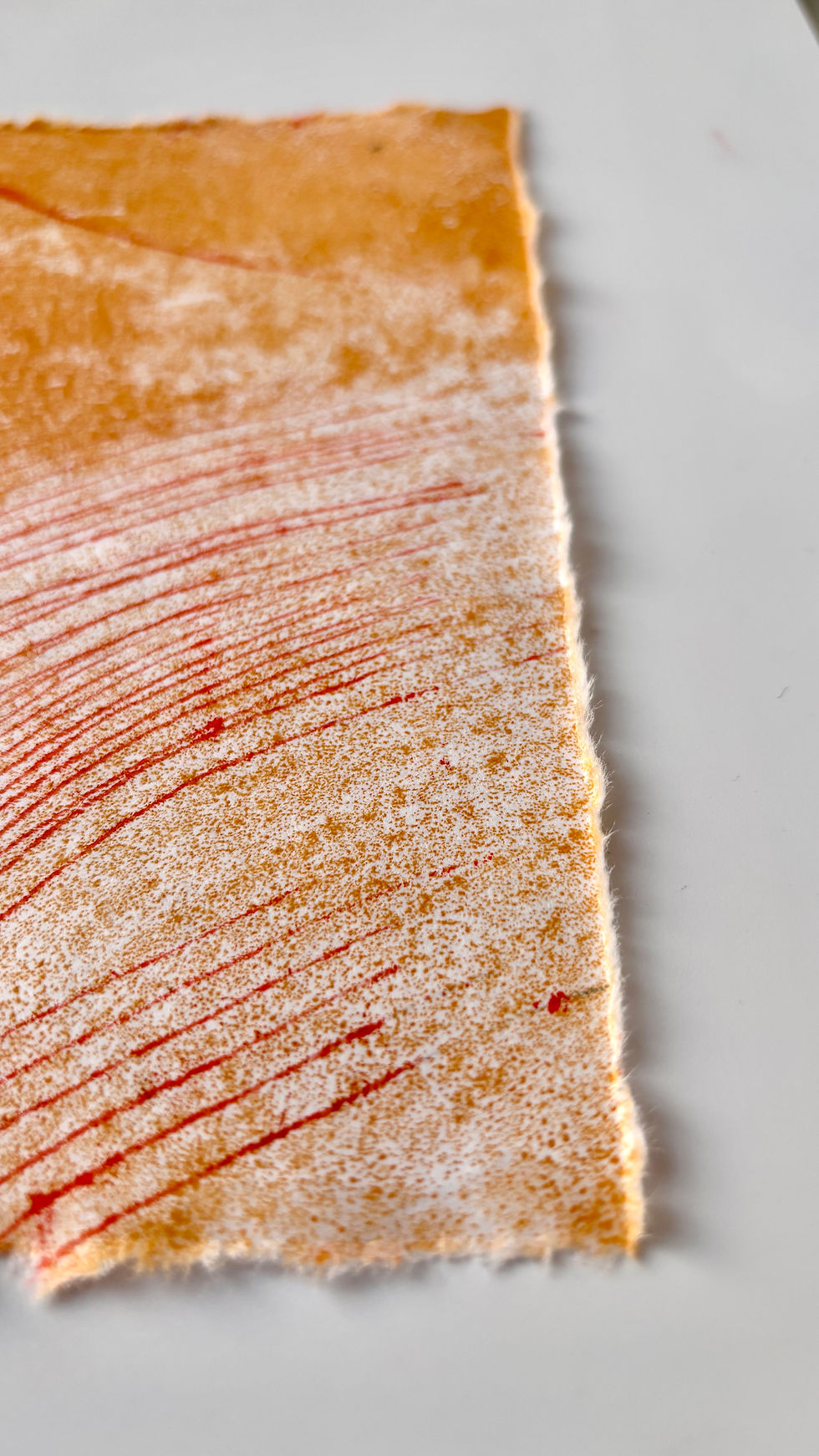
Methyl cellulose is a plant-derived binder: vegan, archival, and compatible with the water-based approach I use across much of my practice. It gives the pigment just enough body to sit on the paper surface without cracking or flaking.

The results are soft, matte, and deeply material, the paper and the pigment feel like one thing, not a surface with a coating applied.
When these pre-coloured sheets are used in chine collé, the printed image sits over a ground that already carries place, already carries the landscape. The Lincolnshire landscape, its chalk and its red clay, can become present in the print.
For collectors interested in provenance and material story, this matters. These are not prints just made with commercial products assembled at the press. The paper has been coloured by hand. The making extends back in time.
Plain or Patterned?

Working with both plain and pre-printed tissue in chine-collé opens up a real conversation between layers. Plain kozo is almost transparent under the press — it carries the intaglio line of a collagraph or drypoint cleanly, the plate mark pressing it into the Somerset with quiet precision.
But tear a fragment of pre-printed tissue, something already carrying a gestural monoprint, a rolled ink texture, or marks made with a hammer and found tools, and the chine-collé becomes a mixture of two print moments.
The pressed impression reads through and against what's already there, doubling the surface history. Marks made with found tools have a particular quality in this context: unpredictable, carrying the weight and edge of the object itself. Laid into a drypoint or collagraph, they sit somewhere between accident and intention, which is exactly where the most interesting things happen.
Zinc Plates: New Experiments in a Familiar Process

Alongside the collagraph work I have begun introducing a zinc plate into the sequence. The zinc sits within the same print, used either as a blind deboss, pressing into the paper without ink, creating a raised or recessed rectangle of pure embossment, or inked, adding a clean geometric element to what is otherwise an organic, textural surface.
In the book Printmakers secrets by Anthony Dyson, Brenda Harthill reminds us - 'When adding chine colle or metal leaf to a print the plate is inked or wiped first. Shards and sheets of metal leaf are laid directly onto the metal plate, either roughly torn or precisely cut as the image requires. ...'The joy is that the inked image will overprint onto the leaf' (or tissue).
Blind Deboss vs Inked Zinc: Two Different Presences
As a blind deboss, the zinc rectangle acts as a frame or a field, visible only in the right light, a shadow of itself. Artists often talk about work needing a small place to rest the eyes, for them to sit and focus on. I would suggest that even the frame created by the zinc plate depression created this.
Inked, the zinc behaves very differently. It introduces a hard-edged, even tone into a surface of considerable complexity. The flatness reads as deliberate interruption, a pause, a silence, a space for the eye to rest before moving back into the textured collagraph field. I am doing this and also looking at bleed prints where the image I print goes right to the very edge of a paper.

For Collectors: Why These Prints Are Unrepeatable
Collagraph and chine collé together produce editions of genuine rarity. Even within a numbered edition, no two prints are identical. The collagraph wears with each printing; the adhesive bond of each chine collé sheet is affected by humidity and the exact moisture content of the backing paper; the hand-coloured grounds vary because they are hand-coloured. The compositions I create are also unique. What is consistent is the intention.
What varies is everything that makes printmaking interesting.
What Comes Next
I will continue to experiment with creating papers for Chine colle. Some I will use in print and others I will add to my paper bowl project. It is very much a work in progress and another learning curve. its another way of testing the strength and luminosity of various papers.
My chine colle experiments will continue and are part of a larger project: developing a layered print that holds multiple processes — collagraph, chine collé, gestural ink work, zinc, within a single cohesive image.

The challenge is compositional, tonal, about knowing when to stop. This new direction is exciting me and I hope you have enjoyed a glimpse at what I am doing.
If you are a printmaker working with similar materials, or a collector curious about process, I am always glad to hear from you. Please comment- I do read and respond to each one.


Comments